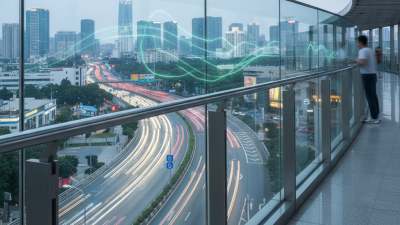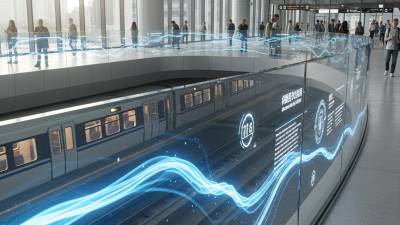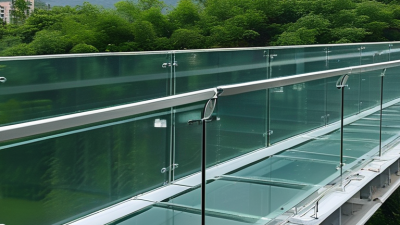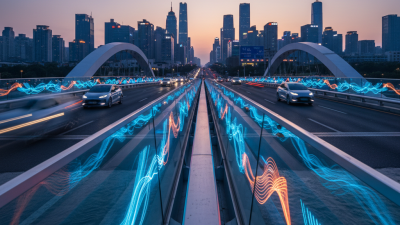
Transparent Guardrail Display Screen technology is moving from visual experimentation toward practical architectural use. By 2026, leading manufacturers will be judged by more than brightness or novelty. They must demonstrate optical clarity, structural compatibility, weather resistance, serviceability, and stable long-term performance.
Dr. Peter Bocko, a longtime glass and display technology specialist, described the central challenge this way: “The material must support optical performance, mechanical strength, and manufacturing reliability at the same time.” That principle is especially important for transparent guardrails. A screen may look impressive in a showroom, yet fail when exposed to direct sunlight, dust, vibration, or constant public contact. Real projects need controlled luminance, safe cable routing, reliable heat management, and carefully tested mounting systems. Small details matter.
This 2026 manufacturer overview examines companies developing Transparent Guardrail Display Screen solutions for commercial buildings, transport hubs, hospitality venues, and premium public spaces. It considers display brightness, transparency, pixel structure, glass integration, customization, maintenance access, energy consumption, and technical support. Factory capacity also matters. So does documented testing.
The market remains immature in several areas. Product claims are not always comparable. Installation data can be limited. Some “transparent” screens also reduce visibility more than buyers expect. That deserves honest attention.
The strongest manufacturers will not simply sell a bright panel. They will provide a dependable system that respects safety, design intent, and everyday maintenance. Performance must be proven on the railing, not only in promotional images.
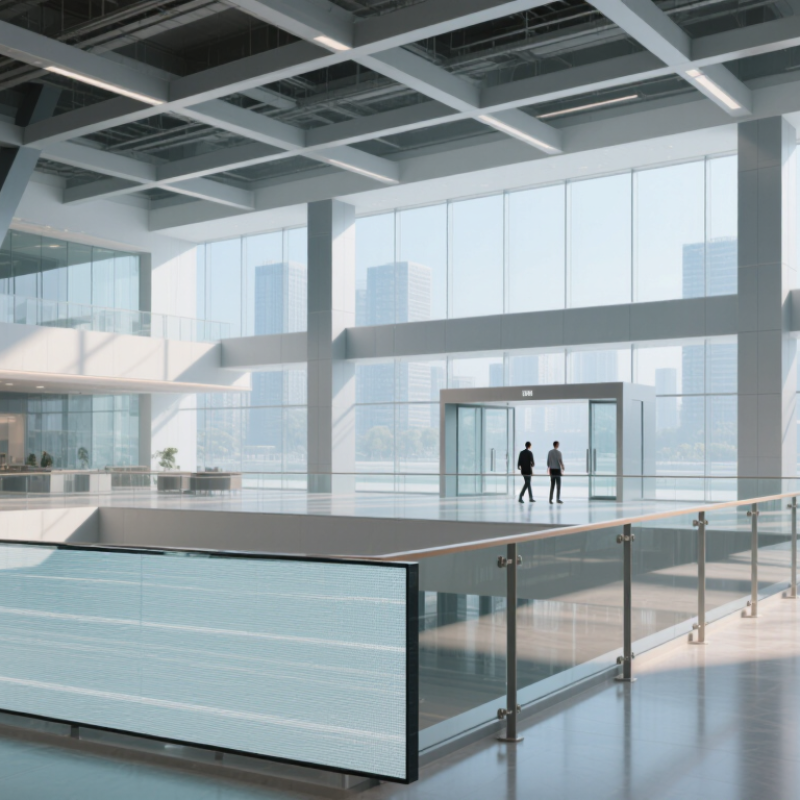
Transparent guardrail displays combine structural railing elements with LED modules, creating images without fully blocking the view. Their 70–90% transparency comes from open spacing between light-emitting components. Daylight can still pass through, while animated content remains visible from nearby paths and platforms.
Pixel pitch controls image detail. A 2.5 mm pitch produces sharper text and close-range graphics, but it usually requires tighter manufacturing tolerances. Larger pitches, such as 6–10 mm, suit viewing distances across plazas, bridges, and transport halls. They can reduce cost and simplify maintenance. However, fine pitch does not automatically improve performance. Brightness, viewing angle, contrast, and control software also matter.
Experienced installers check more than screen specifications. They measure glare at eye level, inspect cable routing, and confirm that display frames do not weaken the guardrail system. Weather sealing, impact resistance, ventilation, and safe electrical isolation require documented testing by qualified engineers. A practical mistake is treating transparency as a fixed number. It changes with pitch, module density, lighting, and viewing direction. Night scenes may look clear, while direct sunlight exposes weak contrast. Field testing remains essential. Some designs look impressive in a showroom, yet lose readability outdoors. That gap deserves honest review.

2026 Top Transparent Guardrail Display Screen Manufacturers
For 2026, transparent guardrail displays should be judged by measurable performance, not showroom brightness. A 3,000–6,000 nit range supports readable images beside sunlit roads, atriums, and station entrances. However, peak brightness can fall during thermal protection. Test results should include sustained brightness, viewing angle, power draw, and color stability.
IP65 is another practical benchmark. Under IEC 60529, the first 6 confirms dust-tight protection, while the second 5 covers water jets. It does not confirm protection against immersion. Installation teams should inspect cable entries, seals, and drainage paths. Small gaps often become expensive failures.
The 100,000-hour claim needs careful interpretation. U.S. Department of Energy guidance explains that LED life is commonly measured through L70, meaning output declines to 70 percent of its initial level. It does not always mean zero component failures. Independent testing should record temperature, operating hours, brightness settings, and maintenance intervals. A display running at maximum output all day may age faster than laboratory estimates. That uncomfortable detail matters. Field records are still limited. Manufacturers should publish test conditions, not only headline numbers.
| Evaluation Dimension | 2026 Target Requirement | Recommended Acceptance Range | Verification Method | Evaluation Weight | Why It Matters for Guardrail Displays |
|---|---|---|---|---|---|
| Peak Luminance | 3,000–6,000 nits | Minimum 3,000 nits; preferred range 4,000–6,000 nits for direct-sunlight locations | Measure the calibrated white field with a luminance meter after thermal stabilization | 15% | Higher luminance improves daylight readability, but excessive output can increase power consumption and heat. |
| Outdoor Ingress Protection | IP65 minimum | IP65 for dust-tight construction and protection against water jets | IEC 60529 ingress-protection testing performed on the complete assembled enclosure | 15% | Guardrails are exposed to dust, rain, cleaning spray, and water jets. IP performance must apply to the finished display assembly. |
| LED or Display-Service Life | 100,000 hours target | 100,000 hours to the stated maintenance threshold, such as L70, under defined operating conditions | Review LM-80/TM-21 data for LED packages and separate accelerated-life or field data for the complete display | 15% | A lifetime figure is meaningful only when the measurement threshold, temperature, drive current, and duty cycle are disclosed. |
| Transparency | Preserve visibility through the guardrail | Approximately 60%–90%, depending on pixel pitch, structure, and viewing angle | Measure open-area ratio or optical transmittance using a defined test geometry | 10% | High transparency supports architectural visibility and reduces the visual obstruction created by the display. |
| Pixel Pitch and Viewing Distance | Match resolution to the installation distance | Fine-pitch formats for close viewing; larger pitch for long-distance signage | Compare pixel pitch, module dimensions, and minimum recommended viewing distance | 8% | Pixel pitch affects image sharpness, transparency, module weight, and total system cost. |
| Brightness Uniformity | Consistent appearance across the full screen | At least 90% average luminance uniformity at a fixed test brightness | Measure multiple points across the display and calculate minimum-to-maximum or average uniformity | 8% | Uniformity reduces visible hot spots, dark zones, and distracting differences between modules. |
| Color Performance | Stable, calibrated color reproduction | Documented white-point setting, grayscale performance, and calibration procedure | Use a colorimeter or spectroradiometer to measure white point, grayscale, and color consistency | 7% | Accurate color improves advertising, wayfinding, public-information, and architectural content quality. |
| Operating Temperature | Suitable for the installation climate | Common outdoor design target: approximately −20°C to +50°C, subject to thermal design | Review controlled-environment operation tests and thermal derating documentation | 7% | Temperature affects brightness stability, component aging, condensation risk, and maintenance intervals. |
| Wind and Mechanical Robustness | Engineered for the site-specific load case | Structural calculations and fixings rated for local wind speed, span, and mounting arrangement | Check project-specific structural calculations; use relevant local building-code requirements | 6% | Transparent panels mounted on railings can experience vibration and wind loads that differ from wall-mounted screens. |
| Electrical Safety and EMC | Compliant power and signal design | Documented protection against overcurrent, surge, short circuit, and electromagnetic interference | Review applicable regional safety, EMC, and low-voltage conformity test reports | 5% | Outdoor public installations require stable operation and controlled electrical risks in accessible areas. |
| Power Efficiency | Controlled energy use at required brightness | Publish typical and maximum power consumption separately, measured at a stated brightness level | Measure input power with calibrated equipment during white-field and typical-content operation | 4% | Power consumption influences operating cost, heat dissipation, cabling, and available electrical capacity. |
A useful ranking of transparent guardrail display manufacturers should compare pixel pitch at the actual viewing distance, not just list the smallest number. For a corridor viewed from one or two metres, a finer pitch can sharpen text and diagrams, but it may raise cost and power demand. Ask for a close-up photo and a brightness reading under daylight. Small details matter. Grand View Research’s LED Display Market Size, Share & Trends Analysis Report (2024–2030) valued the global LED display market at about US$7.5 billion in 2023 and projected 8.2% annual growth through 2030. That broad market figure signals expansion, not proof that every transparent guardrail product is suitable.
Safety glass deserves equal weight. Compare documented impact-test results, glass thickness, edge protection, and how the display assembly transfers loads into the railing structure. A bright screen cannot compensate for unclear safety documentation. Modular design is the third test: can technicians replace one panel without removing a long run of railing? Check spare-module availability, cable access, and whether a damaged section leaves adjacent panels working. Request drawings, test records, and a sample viewing test before ranking suppliers. One imperfect detail remains: published pitch figures are not always measured consistently, so rankings should explain their test conditions rather than imply false precision.
Benchmark comparison by pixel pitch, laminated safety-glass thickness, and modular panel width
The chart compares representative transparent display configurations used in guardrail and architectural applications. Pixel pitch values of 3.9 mm, 6.67 mm, and 10 mm reflect commonly specified transparent LED formats; safety-glass values represent typical laminated glass thicknesses of 8.76 mm, 10.76 mm, and 12.76 mm; modular widths indicate commonly used 500 mm, 1,000 mm, and 1,200 mm panel formats. Lower pixel pitch provides finer image detail, while thicker laminated glass and wider modular formats generally support enhanced protection and installation efficiency.
A 160° viewing angle should be verified on the installed screen, not accepted from a datasheet alone. Check visibility from both sides, including near the ends of the railing, where the image may dim or reflect glare. A simple site check with a test pattern can expose problems before final mounting. Small mismatch. Big consequence.
For 24–48 V DC systems, confirm the display’s rated input, cable length, and voltage drop under full brightness. Measure voltage at the screen, not only at the power supply. Keep power connections accessible for inspection, and record operating voltage during commissioning. These details are easy to overlook when the display looks bright in a workshop.
Load testing must assess the complete guardrail assembly, including posts, anchors, and supporting structure; the display itself should not be treated as a structural guard. The 2021 International Building Code, Section 1607.8.1, specifies guard loads of 50 pounds per linear foot and a 200-pound concentrated load, subject to applicable local requirements. ASTM E2358 provides a performance framework for glass in permanent railing systems. Have qualified professionals document the test setup and results. A screen that survives handling may still fail when its mounting flexes.
For transparent guardrail displays, ownership cost starts with the power meter, not the purchase quote. Ask for measured watts per square meter at the brightness and content you will actually use. A mostly white screen facing daylight can draw more power than dim promotional content. The U.S. Department of Energy’s Energy Saver guidance says LED bulbs use at least 75% less energy and last up to 25 times longer than incandescent bulbs. That is a useful lighting benchmark, not a direct rating for display panels. Request the screen’s operating-power data and dimming range. Small differences matter across long daily run times.
LED lifespan figures also need careful reading. Ask whether the quoted hours describe gradual brightness decline or expected service life for the complete display. Drivers, wiring, and connectors can fail before the LEDs do. Access matters. Check whether technicians can reach power supplies and modules from the safe side of the railing, without removing large glass sections. A clear maintenance path can reduce labor and venue disruption. I would not assume a slimmer enclosure is cheaper over time; it may make repairs awkward. Compare warranty terms, replacement-part availability, and scheduled cleaning needs. Dust and fingerprints show quickly on clear panels, especially beside bright windows.