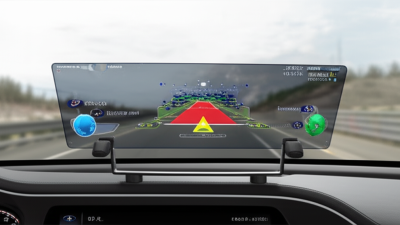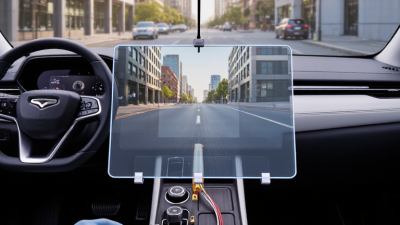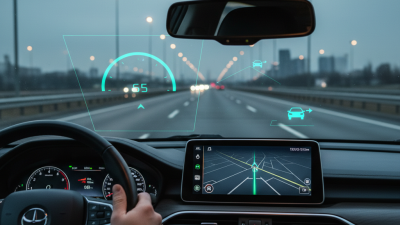
A Transparent Car Display Screen places digital information within the driver’s forward view. It may use a laminated display, projection layer, or transparent OLED panel. Unlike a conventional dashboard, it can show navigation arrows, speed data, warnings, and road-related guidance near the windshield.
The idea feels futuristic.
Dr. Wolfgang Bernhart, a mobility and automotive technology expert, has described this wider industry shift clearly: “The car is becoming a software-defined product.” A Transparent Car Display Screen reflects that change by connecting vehicle software with the driver’s physical environment. A blue navigation arrow might appear above an actual road exit. A warning symbol could align with a detected obstacle. These details may reduce unnecessary glances toward the center console.
However, the technology is not automatically safer. Bright sunlight can weaken contrast. Poor calibration may make virtual symbols appear offset. Too much information can also turn a helpful display into visual noise. Engineers must consider eye movement, response time, windshield curvature, and nighttime reflections. Drivers still need to judge conditions independently.
The term “transparent” can sound more advanced than the hardware really is. Some systems provide partial transparency rather than a fully clear screen. Others depend on projection units hidden inside the dashboard. Performance varies between vehicles, climates, and viewing angles. This article examines how Transparent Car Display Screen technology works, where it offers genuine value, and which practical limitations deserve closer attention before widespread adoption.
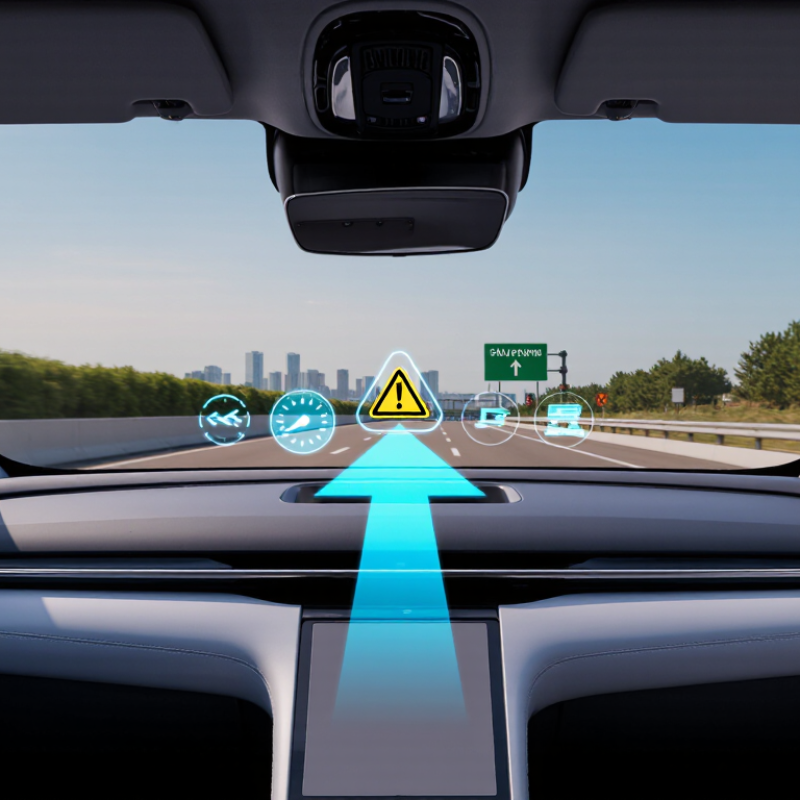
A transparent car display screen is an optical interface that places digital information within the driver’s forward view while preserving visibility through the screen. The term is still used loosely. Some systems use transparent OLED or LCD panels, while others project images through a waveguide or windshield combiner. Their purpose is practical: show speed, navigation arrows, hazard alerts, or vehicle status without forcing the driver to look down. The World Health Organization’s Global Status Report on Road Safety 2023 records about 1.19 million road deaths worldwide each year, making reduced visual distraction an important design objective.
Its core components include a transparent display layer, microdisplay or light engine, projection optics, driver-control electronics, sensors, and a calibrated mounting structure. A windshield-based system also needs a suitable optical interlayer to control reflection, ghost images, and viewing angle.
Brightness sensors adjust the image for tunnels, sunlight, and nighttime driving. Thermal control matters too, because compact electronics can lose performance in a parked vehicle under strong heat. Industry research from MarketsandMarkets identifies head-up displays as a growing automotive display segment, supported by navigation and safety applications, but market forecasts vary by definition and region.
A transparent screen is not automatically safer. Poor contrast, excessive animation, or inaccurate positioning can create new distraction. NHTSA reported 3,047 U.S. traffic deaths in distraction-affected crashes during 2022. That figure should encourage restraint. In real vehicles, optical testing and driver studies matter more than a bright demonstration. The technology remains promising, but its interface design still needs honest refinement.
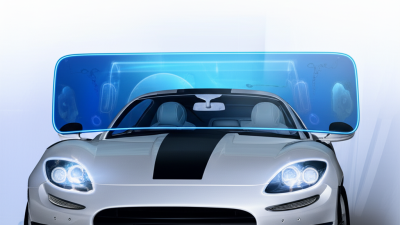
What Is a Transparent Car Display Screen?
A transparent car display screen places digital information over the driver’s view without fully blocking the road. Its performance depends on two key technologies: transparent OLED and MicroLED. Both use self-emitting pixels, so they can avoid bulky backlights. This allows thinner panels and clearer see-through areas.
Transparent OLED can deliver deep blacks, vivid colors, and flexible panel designs. However, sunlight can reduce contrast, especially across a bright windshield. MicroLED usually provides stronger brightness and longer operating potential. Its tiny light-emitting diodes can support demanding daylight conditions. Reaching 70% or higher transparency is possible, but the result depends on pixel spacing, wiring, substrate design, and measurement method. The advertised figure may describe the display area, not the complete glass assembly. That distinction matters.
Tips: Check transparency under direct sunlight, not only in a dark showroom. Ask whether the rating includes protective layers and touch sensors. Look closely at reflections around text and road signs. A screen can be technically impressive yet visually distracting. Calibration should also consider viewing angle, eye height, and night driving. Small testing gaps remain. Engineers still balance brightness, transparency, heat, and durability. A prototype may perform beautifully indoors but feel less convincing on a moving road.
| Performance Dimension | Transparent OLED | Transparent MicroLED |
|---|---|---|
| Operating Principle | Organic light-emitting pixels produce their own light, so no separate backlight is required. | Microscopic inorganic LEDs emit light directly from individually controlled red, green, and blue subpixels. |
| Transparency | Approximately 30%–50% in many practical panel designs; higher values may be possible with reduced circuitry and pixel density. | Potentially 70% or higher because inactive areas can remain largely open; the final value depends on LED spacing, wiring, substrate, and protective layers. |
| Brightness Potential | Generally suitable for indoor and controlled-light environments; brightness can be reduced by transparent electrode and aperture requirements. | Very high brightness potential, making it more suitable for daylight-facing automotive applications when thermal management is adequate. |
| Contrast and Black Level | Excellent native contrast in dark surroundings; ambient light behind the panel can reduce perceived black levels. | Excellent pixel-level contrast and black reproduction when the LEDs are switched off, although background scenery remains visible through the panel. |
| Response Time | Typically very fast, commonly measured in microseconds for pixel response, which helps reduce motion blur. | Extremely fast inorganic LED emission and switching, supporting smooth animations and low-latency graphics. |
| Outdoor Visibility | May require shading, optical enhancement, or higher drive power to remain legible under direct sunlight. | Better suited to strong ambient light because of its higher brightness ceiling, although reflections and glare still require optical treatment. |
| Power Consumption | Power varies with image content; dark graphics can use less power because unlit pixels consume little display power. | Power efficiency can be strong at high brightness, but consumption rises with brightness, pixel density, and the proportion of illuminated pixels. |
| Viewing Angle | Wide viewing angles are possible, but color and contrast can vary according to electrode structure and optical layers. | Naturally wide viewing angles are possible, with performance influenced by packaging, encapsulation, and optical coatings. |
| Automotive Integration | Well suited to windows, partitions, center consoles, and interior information displays where moderate brightness is acceptable. | Promising for windshields, side windows, head-up display concepts, and exterior signaling where high brightness and durability are important. |
| Durability Considerations | Organic materials require effective sealing against moisture and oxygen; temperature management is also important for long service life. | Inorganic emitters are generally resistant to moisture-related degradation, but mass-transfer yield, bonding, heat, and impact protection remain engineering challenges. |
| Image Uniformity | Mature manufacturing methods can provide good uniformity, although transparent circuits may create visible patterns at certain angles. | Uniformity depends heavily on accurate placement and calibration of millions of microscopic LEDs. |
| Technology Readiness for 70%+ Transparency | Possible in specialized low-density or prototype configurations, but achieving high transparency while maintaining brightness, resolution, and durability is difficult. | A strong candidate for 70%+ transparency because the architecture can use widely spaced emissive pixels; production feasibility depends on transfer yield, cost, resolution, and automotive qualification. |
Note: Transparency, brightness, power consumption, and durability vary substantially with pixel density, transparent conductor design, substrate, protective layers, viewing conditions, and display size. Values shown are technology-level ranges or engineering characteristics rather than specifications for a particular product.
What Is a Transparent Car Display Screen?
A transparent car display screen places digital information over the driver’s real view. It may use a windshield projection or a see-through optical panel. Speed, navigation arrows, and warnings can appear without covering the road. The optical design must preserve road visibility, readable contrast, and stable alignment. Small errors become obvious when the vehicle moves.
Automotive display metrics often include a 5–15° field of view and a 2–10 m virtual image distance. FOV describes how wide the projected content appears. A 5° view can present focused information, while 15° supports larger navigation graphics. Wider is not always better. Excessive content may distract the driver. A 2 m virtual image seems close to the vehicle, while a 10 m image appears farther along the road. Greater distance can reduce repeated refocusing, but only when calibration remains accurate.
Measurement needs controlled optical testing and road-based observation. Engineers should check geometric distortion, brightness, contrast, eye box, and image stability. Daylight exposes weak performance quickly. Rain and night reflections can change the result. In practical evaluations, a display may meet its rated FOV yet still feel cramped. That gap matters. Human vision varies, and laboratory numbers cannot fully predict comfort. Some designs also need better adjustment for different seating positions. Reliability comes from repeating tests, recording conditions, and comparing results against real driver behavior.
A transparent car display screen places digital information over glass or a clear panel. It can show speed, navigation arrows, warnings, or cabin controls. In head-up displays (HUDs), projected graphics appear several meters ahead of the driver. This reduces eye movement toward the instrument cluster. MarketsandMarkets estimated the automotive HUD market at about USD 1.1 billion in 2023, with strong growth expected through 2028. Estimates vary, but the direction is clear.
Windshield integration is more demanding. The display must remain readable under direct sunlight, rain, and night glare. Engineers must control brightness carefully. Poor calibration can create double images or distracting reflections. A visible turn arrow should align with the road, not float beside it. Side-window displays support passenger entertainment, privacy shading, and travel information. However, viewing angles, sunlight, and head movement can weaken image quality. The display also needs to remain unobtrusive during emergencies.
Smart consoles use transparent panels for climate settings, charging status, and vehicle diagnostics. They can keep physical space open and improve cabin visibility. Omdia’s automotive display research identifies larger, more integrated screens as a continuing vehicle trend. Yet bigger is not always better. More information can increase cognitive load. I have found that simple layouts feel more trustworthy during real driving. The technology is not flawless. Heat, fingerprints, software delays, and inconsistent contrast still need practical testing. Manufacturers should measure performance across seasons, drivers, and road conditions before claiming a seamless experience.
Typical optical-transmission targets across HUDs, windshields, side windows, and smart consoles
Transparent automotive displays balance image visibility with the driver's view through the surface. Windshields and HUD combiners generally require higher light transmission, while smart consoles can use lower transmission because their primary purpose is information display rather than road visibility. The percentages shown are representative engineering targets, not company or brand data.
A transparent car display screen places digital information within glass while preserving a view of the road. Its value depends less on visual novelty and more on safety performance. Brightness must remain readable in direct sunlight, yet it should not create distracting glare at night. Automatic dimming can help, but poor calibration may make text disappear during sudden lighting changes.
Contrast is equally important. Thin white characters can blend into cloudy skies, buildings, or headlights. Designers should test different colors, backgrounds, viewing angles, and driver positions. Information must appear briefly and clearly. Navigation prompts should support the driver’s attention, not compete with traffic signals, cyclists, or unexpected hazards. Even a well-designed screen can become distracting when it shows too much information.
Tips: Test the display at dawn, noon, rain, and night. Measure brightness and contrast inside a moving vehicle, not only in a laboratory. Keep critical warnings large, simple, and positioned near the normal sightline. Homologation should be treated as an engineering requirement, not a final paperwork step. Regional rules may address field of view, reflections, luminance, symbols, controls, and electromagnetic performance. Independent testing improves credibility and reveals weaknesses early. One assumption may still fail in real traffic. That is why driver trials and repeated review remain necessary.