Choosing a Flexible Transparent Led Film Screen is not simply a matter of comparing prices or advertised transparency. The screen must suit the glass, viewing distance, ambient light, and content. A bright storefront, for example, can make dim visuals difficult to see, while dense graphics may obscure the view behind the glass. Small details matter.
This guide presents seven practical tips for evaluating a screen before purchase. It covers transparency and brightness, pixel pitch, film dimensions, installation requirements, control systems, environmental conditions, and supplier support. These factors affect both the finished display and the work needed to maintain it. A specification sheet can still leave questions unanswered. Ask for current product data, installation guidance, and a demonstration using content similar to your own. If possible, inspect a sample on glass under lighting conditions close to the intended site.
Not every screen fits every window. Reflective glass, unusual dimensions, or changing sunlight can complicate a seemingly simple project. A careful review helps reveal those limits early. The goal is not to find the most impressive claim, but to choose a reliable display that balances visibility, transparency, and practical installation. Some trade-offs are unavoidable, and they deserve an honest look before a final decision.
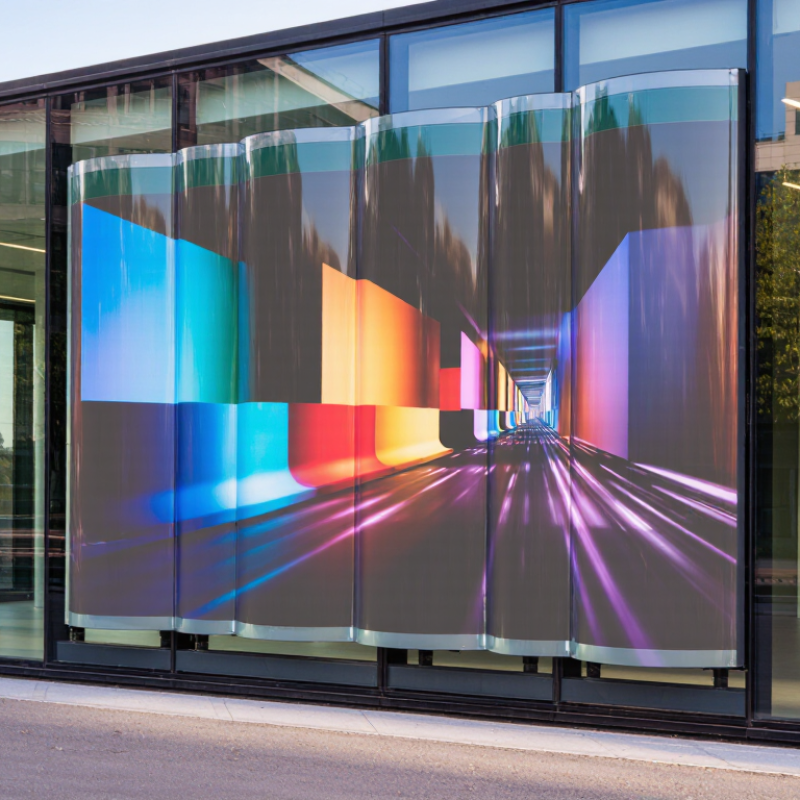
Start by defining what the display must do. Is it meant to show changing promotions, provide wayfinding, or add motion to a glass façade? Each goal calls for different content, brightness, and transparency. Keep the message brief enough to read while someone walks past. A useful test is to view sample content from the actual sidewalk, not just on a laptop. Small text can disappear in daylight. It happens.
Viewing conditions shape the choice as much as the display itself. Check sunlight direction at different times, reflections from nearby buildings, and the typical distance between viewers and glass. Then measure the installation area, including frame edges and mullions. Note the glass type, pane curvature, seams, and any restrictions on accessing the back of the window. Power access and cable routes matter, too. A neat design can become awkward when a cable crosses a visible edge. Review how the film may affect visibility from indoors, and request a small sample for a real-glass test before committing. Measurements are easy to rush; they deserve a second look. A little uncertainty at this stage is better than discovering a poor fit after installation.

When comparing a flexible transparent LED film screen, ask how transparency is measured. A stated 80% transparency can look different once wiring, supports, and window reflections enter the picture. View a sample against both daylight and a dim interior. Details matter. A faint grid may disappear at a distance, yet distract people standing close to the glass. Also check whether the quoted figure applies to the complete installed panel, not just its film.
Brightness needs a real-site test. For a sunlit window, roughly 3,000–5,000 cd/m² may be a useful comparison range; indoor spaces often need less. These are starting points, not guarantees. The U.S. Department of Energy’s 2022 Solid-State Lighting R&D Opportunities report discusses LED package efficacy in lumens per watt; that figure is not screen luminance in nits. Keep the units separate. Ask for measured luminance and viewing conditions, then inspect the display at the brightest hour.
Pixel pitch affects both detail and transparency. A 2.5 mm pitch can suit closer viewing than a 4 mm pitch, but finer spacing may add visible structure and cost. Estimate viewing distance, then test real content: small text, thin lines, and moving footage. Industry measurement guidance such as ICDM’s Information Display Measurements Standard helps define display measurements, but it cannot predict every glass façade. Reflections complicate things. I would not choose from a specification sheet alone.
Measure the glass before choosing a film. Record each pane’s width, height, curvature, and edge clearance; a few millimetres can affect alignment. Ask for the film’s minimum bend radius and compare it with the actual surface, not a showroom sample. A film that flexes easily in your hands may still wrinkle around tight corners. Test a small section first. Check visibility from both sides, too.
Size the active display area separately from the glass area. Leave room for cables, controllers, and service access, especially near window frames. Mounting options may include adhesive application on smooth glass or mechanical support for framed installations. Confirm surface compatibility, cleaning requirements, and whether the film can be removed without residue. The details are easy to overlook. UNEP and GlobalABC’s 2023 Global Status Report found that buildings and construction accounted for 34% of global energy demand in 2022. That figure is not a display-performance measure, but it reinforces a practical check: will the chosen coverage unnecessarily reduce useful daylight? A neat mock-up can hide awkward cable routes, so inspect a full-size installation before committing.
| Tip | What to Assess | Practical Check | Why It Matters |
|---|---|---|---|
| 1 | Confirm the permitted bend direction and radius | Request the manufacturer’s minimum bend radius and installation instructions. Check whether the film can curve horizontally, vertically, or in both directions. | Flexible film does not necessarily bend freely in every direction. Bending it beyond its specified limits can damage components or connections. |
| 2 | Measure the installation area accurately | Record the glass or surface width and height, note obstacles such as frames and handles, and compare the usable area with the available module dimensions. | Careful measurement helps avoid gaps, unwanted overlaps, and difficult cuts or joins. Confirm whether the film can be trimmed before planning a custom fit. |
| 3 | Balance transparency with image detail | Compare the stated transparency and pixel pitch, then view sample content from both the intended viewing distance and the opposite side of the glass. | Higher transparency can preserve more of the view through the glass, while finer pixel spacing can improve image detail. The best balance depends on content and viewing distance. |
| 4 | Check overall dimensions and module layout | Ask for a dimensioned layout showing active display area, borders, cable exits, module seams, and any required clearance around the screen. | The advertised screen size may not include all installation clearances or connection areas. A layout helps confirm that the complete assembly fits the site. |
| 5 | Choose a mounting method suited to the surface | Confirm whether the product uses adhesive, clips, a frame, or another mounting system, and check that the method is approved for the glass or substrate. | Mounting compatibility affects appearance, stability, installation effort, and the ability to remove or service the screen later. |
| 6 | Plan power, signal, and service access | Map cable routes and connection points, and ask how controllers, power supplies, and individual film sections can be reached for inspection or replacement. | Transparent film still requires electrical and signal connections. Planning access in advance can reduce visible cabling and simplify maintenance. |
| 7 | Verify the operating environment and support requirements | Check the product’s specified temperature, humidity, cleaning, and indoor or outdoor limits. Request installation, warranty, and maintenance documentation. | Environmental limits and care instructions vary by product. Confirming them before purchase helps ensure the screen is suitable for the intended location. |
Power figures deserve a real-world check. Ask for consumption at your intended brightness, not only the maximum rating. A storefront running all day may need a lower average load than a short event display. Very different use. Check driver efficiency, dimming behavior, and heat around the power supply. Compare the quoted figures with a sample panel running for several hours. Spec-sheet numbers help, but they do not tell the whole story.
Durability depends on more than advertised lifespan. Confirm the film’s minimum bend radius, operating temperature range, and resistance to dust or moisture. Do not crease it to fit a corner. Edges and cable connections often take more stress than the viewing area. Ask how the screen performs after repeated installation, cleaning, and temperature changes. If test conditions are unclear, treat performance claims cautiously. I would, anyway.
Maintenance should be possible without dismantling the entire window. Check whether power supplies and signal connections remain accessible, and ask what can be replaced if one section fails. Plan to remove dust with a soft, lint-free cloth; harsh cleaners may cloud the surface or weaken adhesive. Confirm who handles troubleshooting and whether replacement parts will remain available. It is easy to overlook service access during a showroom demo. That can become expensive later.
Compare power use, durability, and maintenance needs before choosing a screen.
The scores are an editorial checklist, not measured product specifications: higher scores indicate factors worth prioritizing. Compare rated power consumption, expected service life, installation conditions, warranty, and maintenance access in each supplier’s datasheet.
7 Tips for Choosing a Flexible Transparent LED Film Screen
Evaluate Supplier Support, Warranty, and Total Cost
A low quote can hide expensive service gaps. Ask who handles commissioning, remote diagnostics, and on-site repairs. Get response times in writing, including weekends and public holidays. Ask for proof: a sample service record, spare-parts list, and clear escalation path. Small details matter. Confirm which parts the warranty covers, and whether labor, shipping, pixel failures, and controller replacement are included. Check its limits for operating hours, temperature, humidity, and brightness. A warranty that excludes normal installation conditions may offer little practical protection.
Build a five-year cost estimate covering screen film, controllers, power supplies, installation, energy, maintenance, and eventual replacement. Grand View Research estimated the global digital signage market at US$26.76 billion in 2022, with an 8.1% compound annual growth forecast for 2023–2030. That growth signals a broader market, not guaranteed support for your specific screen. Verify local technician availability and parts lead times. Ask the supplier to price a replacement panel and a service visit separately.
Compare like with like. Request written power-consumption figures at your intended brightness, not only peak settings. Include access equipment and labor if the film sits behind glass or above a busy entrance. I would not assume the cheapest option is poor; sometimes a simpler installation wins. But vague warranty wording is a real cost risk. Keep the quote, approved drawings, test results, and service contacts together. A tidy file can save time later.